Our approach
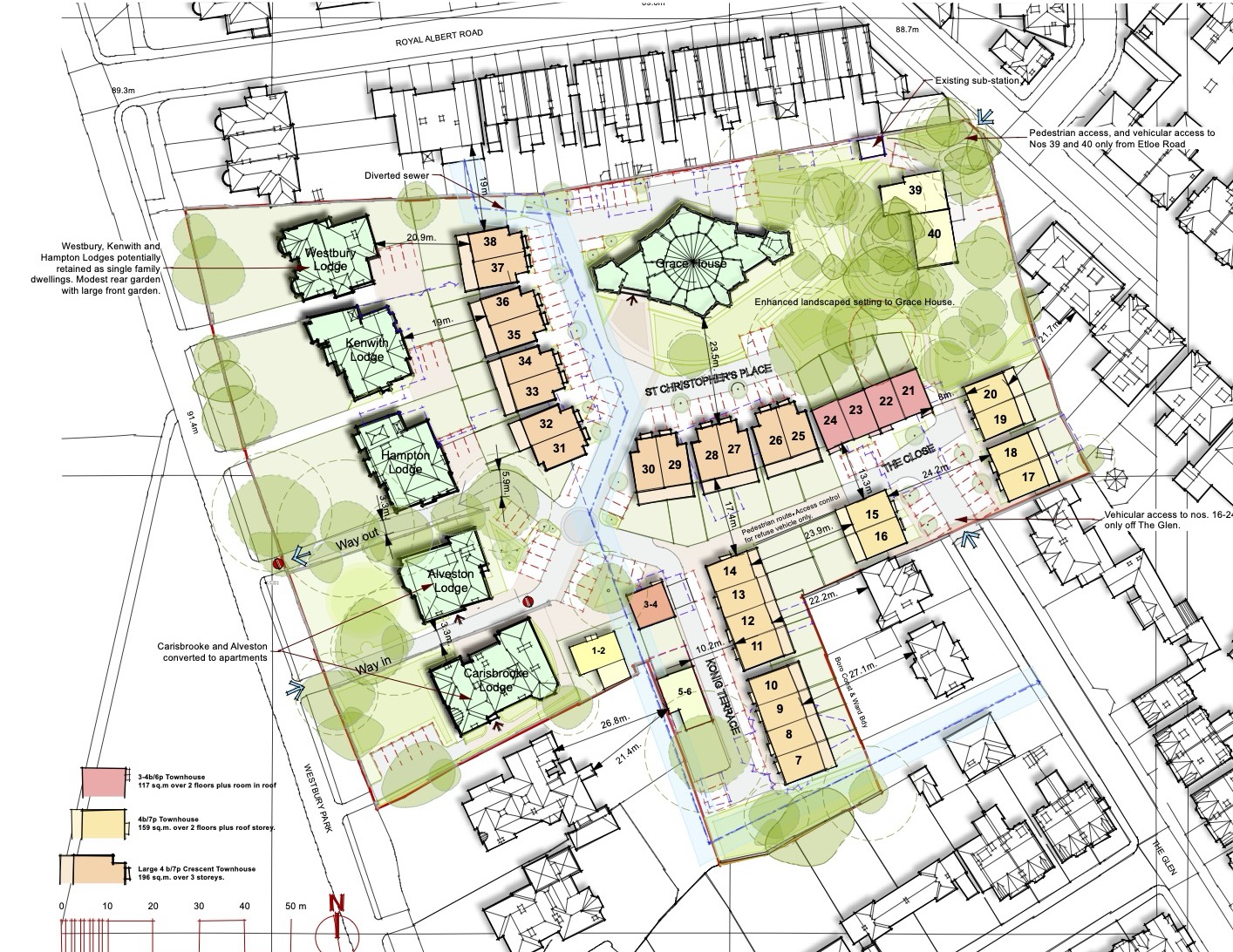
Our initial masterplan
Please understand that our plans are still at an early pre-app stage. We need to present and discuss our approach with Bristol City Council officers and key statutory bodies, like Historic England, Natural England and the Environment Agency. We also need to complete all the technical studies and surveys required to understand the site’s constraints. So, things could change.
However, we wanted to share our thoughts at this stage and invite your feedback .
In developing these proposals we acknowledge the history of the site, the elegance of the villas and contribution of the trees to the site’s character. It is into this suburban framework that we seek to sensitively integrate new houses and apartments and carefully restore a number of existing buildings. Our goal is to create a home for a new community within an established neighbourhood, which will look as if it has been developed organically, and will feel as if it has always been part of Westbury Park.
Our Proposal
Key considerations
Heights
The community planning briefs seeks to limit the building heights to no more than three storeys. This is what we are currently proposing. Just to clarify, when we say three storeys that would include three storey houses with a flat roof, as well as houses that are two storeys but with a room in the roof, something that is commonplace in many of the existing neighbouring properties. We do think there is an argument that slightly taller buildings could be located closest to the rear of the lodges on the basis that, although the lodges are generally three storey, the generous ceiling heights make them closer to a modern four storey house. But – currently – that is not our intention.
Density
As stated above, the initial proposed density sits at 51 dwellings per hectare (dph). This is calculated against 1.04 hectares, as the remainder of the 1.99 hectare site is unsuitable for new build development. We do need to be mindful that Bristol City Council’s policy in a location like this would be to seek a minimum density of 50 dph.
Proximity
Understandably, residents with homes backing onto the site wish to retain their privacy. The community planning brief seeks minimum distance between habitable rooms of at least 21 metres, and a distance of at least 12 metres between new buildings and the rear boundaries of existing properties. This will need to be explored with individual property owners, but our current layout proposes distances between new homes and the rear of existing homes ranging from 19 metres up to 27.1 metres.
Tree protection
Our specialist arboriculture consultants undertook a comprehensive survey of trees in February 2026, including recording all Tree Preservation Orders.
We will retain as many trees as possible, and ensure that new buildings are kept clear of root protection areas. However, not all trees can be retained, particularly those of lower visual, ecological or arboricultural value. Cypresses (Lawson and Leyland) generally are to be removed. These have dense foliage and crowd out other species, negatively impacting biodiversity due to their crown density. There is also a Monterey cypress which has a TPO which we propose to remove, based on its impact on other trees. Smaller trees in the centre of the site will also be removed. These are generally C1 category and contribute little in visual terms. The ash at the gateway to Carisbrooke has been downgraded to C1 category due to its siting, condition, and presence of ash dieback.
Vehicle access
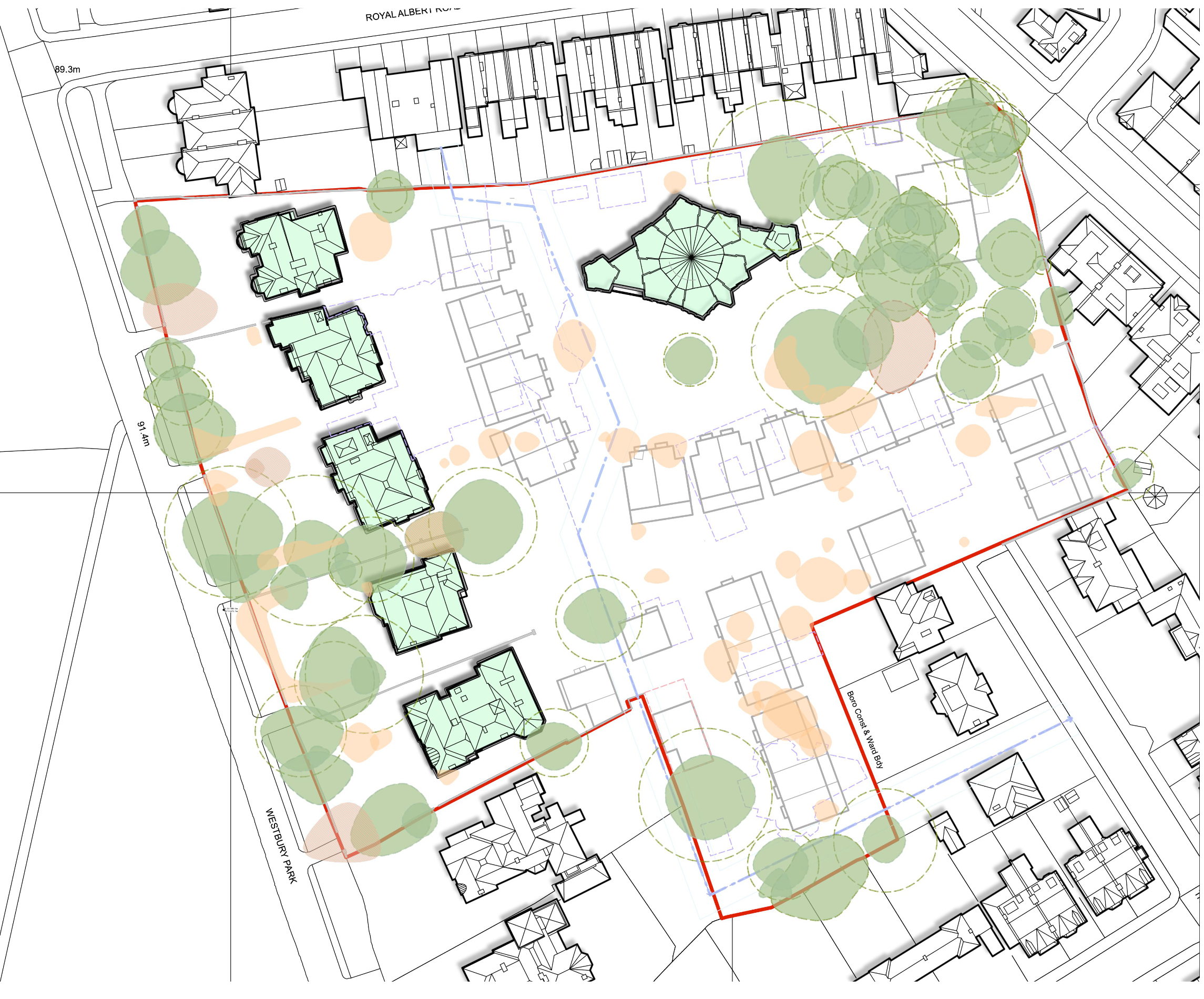
The main vehicle access into and out of the site will be from Westbury Park. The existing access off Etloe Road would be retained for two new homes. We are also proposing a new, additional vehicle access off The Glen – this would only be to serve the ten new homes proposed as an extension to The Glen cul-de-sac. This new access would not be a through route other than for refuse vehicles. As part of this design we are proposing a turning ‘hammerhead’ within the site. This could help reduce the number of vehicles currently turning in the middle of The Glen where there is insufficient space and reduce the numbers needing to negotiate the currently difficult access onto Westbury Park.
Parking
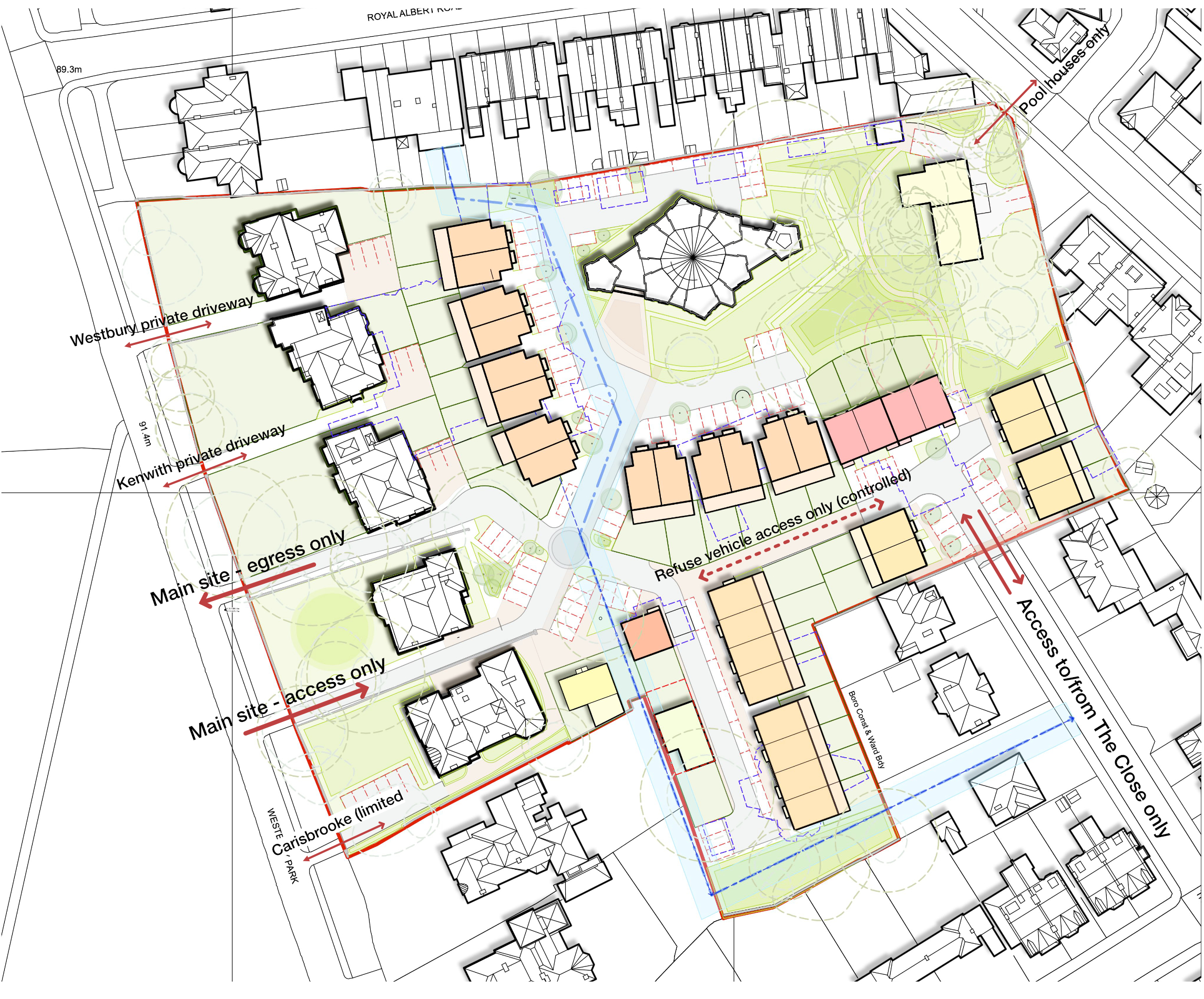
Our preference is to ensure there is sufficient parking onsite for all of the homes being proposed. In seeking to reduce car usage, Bristol City Council has introduced a maximum parking level which we cannot exceed. We will, however, seek the highest number of spaces the policy will allow. We anticipate all homes will have access to electric vehicle charging.
The lodges
All of the lodges will be retained and fully renovated. They will be a mixture of individual houses and apartments. The front gardens will be restored to their former glory.
Grace House
The community planning brief insists any development avoids adverse impacts on Grace House. We intend to retain, restore and convert Grace House into apartments. We also propose to enhance its setting with open space around it and by retaining the wooded area to the east. The other buildings built between the 1960s and the 2000s will be removed.
Pedestrian routes
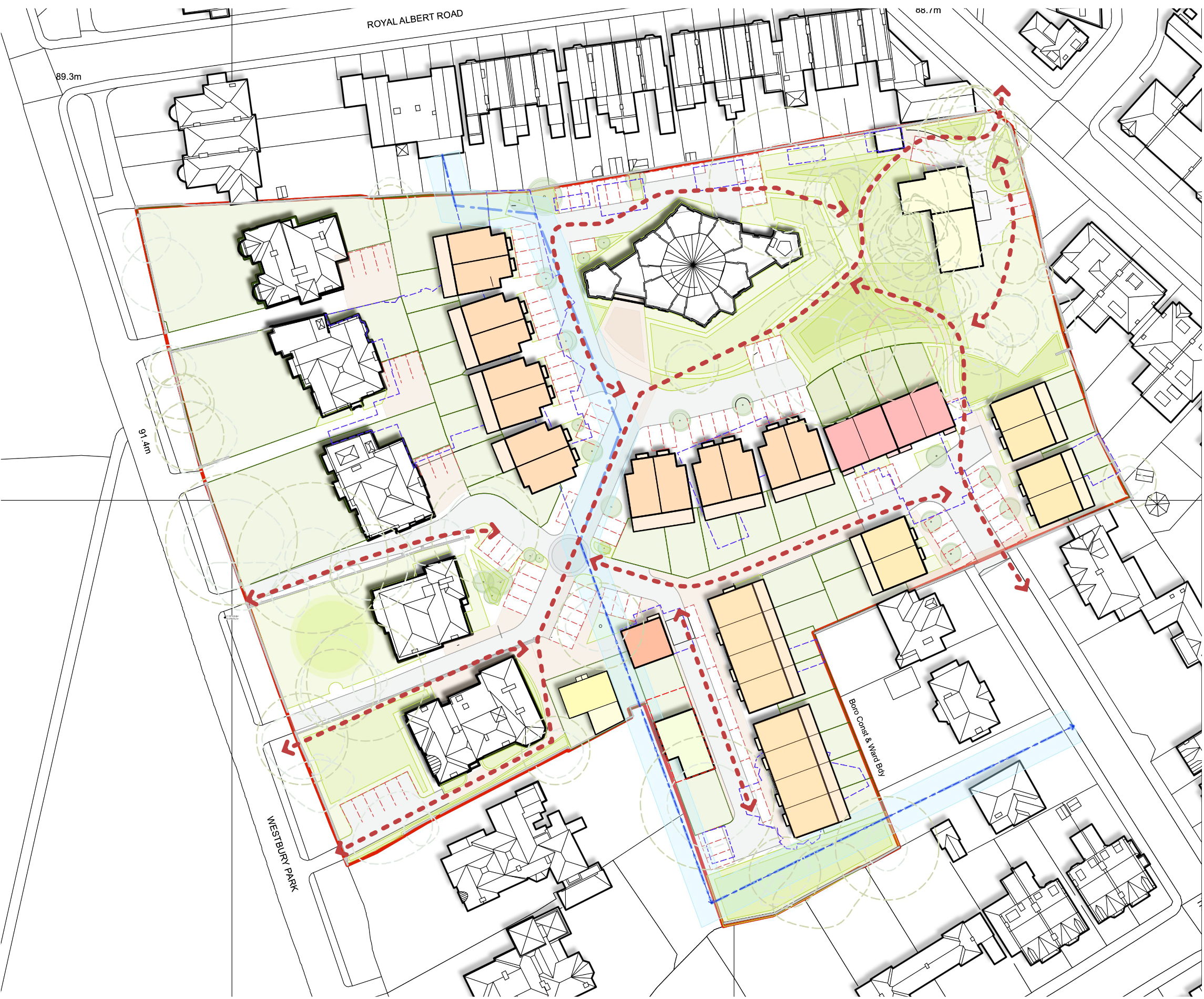
The plan shows all the possible pedestrian routes around the site but pedestrians will be encouraged to follow two main routes across the site from Etloe/Bayswater to The Glen and from Etloe/Bayswater to Westbury Park. We will aim to promote movement and prioritise pedestrians and cyclists across the site with our developing design.
Public open spaces
We have yet to complete a draft landscape strategy, though will share this with the community in the coming weeks. However, as you can see on the draft masterplan the main wooded area to the east of Grace House will be the focus for public open space. Previously there was no public access to the site, so we feel there is an opportunity to provide something the community values. We may be able to incorporate other landscaping and public open space features and welcome your suggestions.
Social value, including SEND
The community planning brief robustly states the need for any scheme to deliver community benefit. We agree. The community brief urges that social value be focussed on provision for children with Special Educational Needs and Disabilities (SEND). This is something we are exploring with SEND stakeholders. It won’t be any form of SEND school. But it could be provision of holiday accommodation designed to meet SEND needs. Or it could focus on sensory gardens. These are early thoughts, and we welcome other suggestions. We do understand that the loss of the St Christopher’s School was a real blow for local residents. We appreciate delivering these services is complex, but we note that – in March – Bristol City Council announced it has committed £53M to existing SEND schools: https://news.bristol.gov.uk/press-releases/1c606add-9540-4273-be18-1d2da91438c7/bristol-city-council-to-decide-on-53-million-send-expansion-plan.
Sustainability
We will be looking at ways to ensure the build, renovation and running of the buildings meet the highest sustainability and energy efficiency standards. This is much more straightforward for the new buildings which will meet or exceed the extremely demanding latest building regulations. Retrofitting the existing buildings is more of a challenge that we will be working through over the coming months. Some of the key principles include maximising daylight and passive solar gain whilst avoiding overheating; fabric first approach to energy efficiency; low carbon energy systems; renewable energy generation, notably solar photovoltaics; onsite electric vehicle charging; and water saving measures.
Our approach will be confirmed as soon as we have feedback from BCC on its treatment of the emerging Local Plan policy context for this application. We have requested this feedback as part of our pre-app submission.
Ecology
Surveys are ongoing, but the site is already home to a number of species, including bats, birds and mammals (there also appears to be an existing issue with rats). It also currently forms an important wildlife corridor between Westbury Park and the Downs. We have yet to develop a landscape strategy but that will include retaining key wooded areas and creating new opportunities to boost biodiversity on the site. We will have more to share in the coming weeks and months.
